Why Most Travel Apps Are Built Around Booking When the Real Customer Journey Starts Before Booking
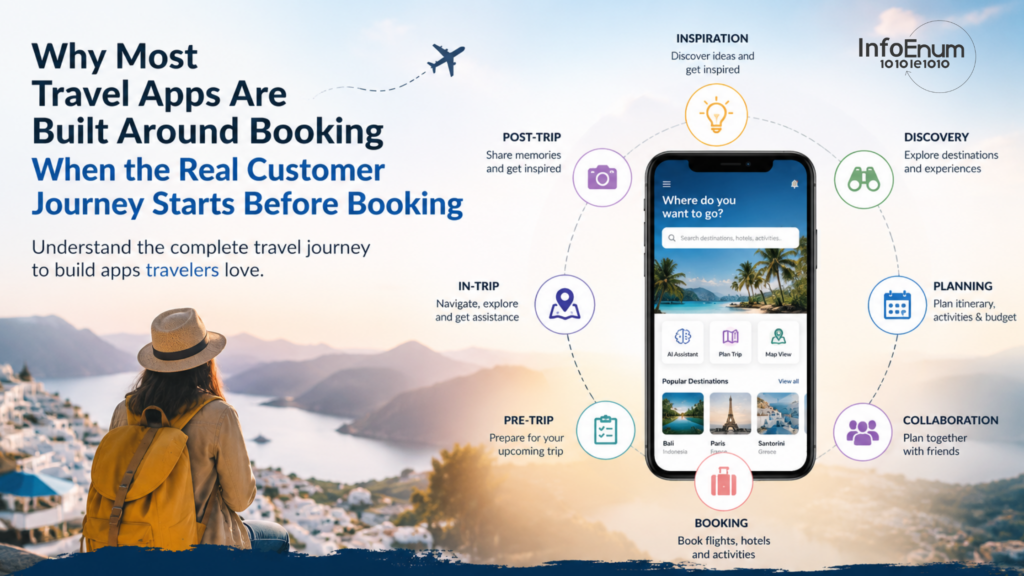
Travel has changed. Travelers no longer open an app only when they are ready to book a flight or hotel.
The journey often begins weeks or even months before the booking.
A traveler may first see a destination on social media, save a place on a map, compare hotels, discuss plans with friends, build an itinerary, look for activities, and only then make a booking.
Yet many travel apps are still designed around one primary objective:
Search → Select → Book
For modern travel businesses, that approach may leave some of the most valuable parts of the customer journey untapped.
The Travel Customer Journey Starts Long Before Booking
A typical travel journey looks more like this:
Inspiration → Discovery → Research → Planning → Collaboration → Booking → Pre-Trip → In-Trip → Post-Trip
Booking is only one stage.
The opportunity for travel companies is to become part of the traveler’s journey before, during, and after the transaction.
This creates more opportunities for personalization, engagement, customer loyalty, and revenue.
1. Travel Inspiration Comes Before Travel Search
Travelers often don’t begin with a specific booking request.
They start with questions such as:
- Where should I travel?
- What can I do there?
- Where should I stay?
- Is this destination suitable for my budget?
- What should I see?
- Can I plan this trip with my friends?
A modern travel app can use AI-powered recommendations, personalized content, destination discovery, and saved travel ideas to capture this early intent.
This is where travel applications can move from being a booking tool to becoming a travel discovery platform.
2. Planning Is a Major Part of the Travel Experience
Once travelers choose a destination, they need to organize their trip.
They may need to:
- Create an itinerary
- Save hotels and activities
- Organize destinations on a map
- Compare options
- Plan routes
- Share plans with friends
- Estimate costs
- Coordinate dates
This creates an opportunity for travel companies to build useful planning features directly into their applications.
Instead of asking the customer to leave the app and use several other products, the travel platform can become the central place for planning the trip.
3. Personalization Can Start Before the Booking
One of the biggest opportunities for modern travel apps is personalization.
Consider two travelers searching for the same destination.
Traveler A:
Family trip, $3,000 budget, prefers resorts and cultural activities.
Traveler B:
Solo traveler, $1,000 budget, prefers adventure and local experiences.
Showing both travelers the same recommendations creates a generic experience.
A smarter travel application can use:
- Previous trips
- Saved destinations
- Search behavior
- Budget
- Travel preferences
- Interests
- Trip type
to create a more relevant experience.
This is where AI and recommendation engines can add significant value.
4. AI Can Connect Discovery, Planning and Booking
AI in travel should not simply mean adding a chatbot.
The larger opportunity is creating an intelligent travel assistant that understands the customer’s intent and helps throughout the journey.
For example:
“I want to spend five days in Italy with my family, keep the budget under $4,000, and include activities suitable for children.”
An AI-powered travel platform could help generate:
Destination recommendations → Hotels → Activities → Itinerary → Maps → Estimated cost → Booking options
The goal is not to replace the booking engine.
The goal is to make the entire journey easier.
5. Maps and Social Features Can Increase Engagement
Travel is increasingly collaborative.
People plan trips with:
- Partners
- Families
- Friends
- Groups
- Other travelers
Features such as shared itineraries, interactive maps, saved locations, recommendations, and trip sharing can turn a travel app into a more engaging product.
This also creates additional opportunities to understand traveler preferences and provide personalized recommendations.
From Booking App to Travel Journey Platform
The future of travel applications isn’t necessarily about adding more booking features.
It is about connecting the different stages of the traveler’s journey.
A modern travel platform can evolve from:
Booking Platform
Search → Compare → Book
to:
Travel Journey Platform
Discover → Plan → Collaborate → Personalize → Book → Experience → Re-engage
This creates a stronger relationship between the traveler and the brand.
What Should Travel Companies Build Next?
If you already have a travel booking application, you don’t necessarily need to rebuild it.
A practical roadmap could be:
Phase 1 — Improve Discovery
Personalized destinations, travel inspiration, saved ideas and recommendations.
Phase 2 — Add Planning
Itineraries, maps, activities and collaborative trip planning.
Phase 3 — Introduce AI
AI-powered recommendations, itinerary generation and conversational travel assistance.
Phase 4 — Connect Booking
Allow users to move seamlessly from planning to hotel, flight, activity or experience booking.
Phase 5 — Extend the Journey
Pre-trip notifications, in-trip assistance, recommendations and post-trip engagement.
The Key Takeaway
The biggest opportunity for travel businesses may not be getting a customer to book faster.
It may be becoming part of the customer’s journey earlier.
When a travel app helps someone discover where to go, plan what to do, collaborate with others, personalize the experience and finally complete the booking, the platform becomes much more than a transaction engine.
It becomes a digital travel companion.
At InfoEnum, we have worked across different areas of travel technology, including travel booking, trip planning, maps, AI-powered travel discovery and travel communities. This experience gives us a practical perspective on how travel products can evolve from individual features into connected digital travel experiences.
Building or modernizing a travel application?
We can help you evaluate your existing product, identify opportunities across the customer journey, and define a scalable roadmap for mobile, web, AI, booking, maps and travel integrations.