Years Of
Experience
Projects
Delivered
Happy Clients
Worldwide
Client
Retention
 AI Strategy & Road mapping Generative AI Development AI Chatbot & Virtual Assistants Machine Learning Solutions Data Analytics & BI Data Engineering AI-powered Process Automation AI Integration Services AI Strategy & Road mapping Generative AI Development AI Chatbot & Virtual Assistants Machine Learning Solutions Data Analytics & BI Data Engineering AI-powered Process Automation AI Integration Services AI Strategy & Road mapping Generative AI Development AI Chatbot & Virtual Assistants Machine Learning Solutions Data Analytics & BI Data Engineering AI-powered Process Automation AI Integration Services AI Strategy & Road mapping Generative AI Development AI Chatbot & Virtual Assistants Machine Learning Solutions Data Analytics & BI Data Engineering AI-powered Process Automation AI Integration Services AI Strategy & Road mapping Generative AI Development AI Chatbot & Virtual Assistants Machine Learning Solutions Data Analytics & BI Data Engineering AI-powered Process Automation AI Integration Services

InfoEnum developed an interactive Business Intelligence dashboard that transforms enterprise data into meaningful business insights.

InfoEnum modernized enterprise infrastructure through cloud migration, DevOps automation, and scalable cloud architecture solutions.
InfoEnum built a scalable eCommerce marketplace that enables businesses to manage products, payments, vendors, and customer orders efficiently.

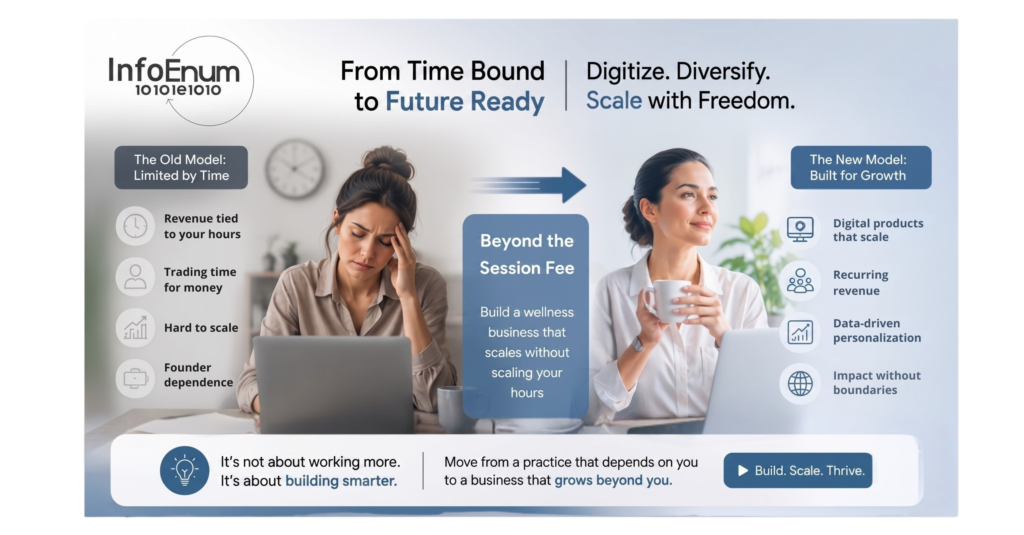
The biggest growth constraint for most wellness businesses isn’t finding clients.
It’s selling time.
One coach. One room. One hour. One client. You can raise your fees, hire more practitioners, run more workshops, but at some point, growth simply requires more hours than a day has.
This isn’t a delivery problem. It’s a business model problem.
Most wellness and mental health businesses run on a single revenue lever: live sessions.
Coaching calls. Therapy sessions. Workshops. Corporate trainings.
Everything else, content, resources, follow-up usually exists to support that one lever, not to earn on its own.
So founders work harder to grow, instead of building something that grows independently of their calendar.
To be clear, this isn’t an argument against sessions. The highest-performing wellness businesses still center on expert-led care. The shift is about adding scalable revenue alongside it, not replacing the relationship that makes wellness work in the first place.
Picture a therapist who has run the same 12-week anxiety protocol with hundreds of clients. Turned into a structured, self-paced course, say, a $199 program, that same expertise can now reach people who aren’t ready (or able) for 1:1 sessions, while still funneling the right clients into deeper, paid therapy.
A nutrition coach launching a $39/month membership, habit tracking, weekly content drops, monthly group calls, replaces unpredictable, one-off bookings with recurring income. For clients, it also means continuity of care between sessions, not just a transaction.
As platforms track progress, habits, and engagement, that information can power more personalized plans and recommendations, and a premium tier built around that personalization. To be clear: this is about insights for the client’s benefit, not selling user data. Done well, and with privacy handled properly, it’s simply a more tailored, more responsive experience that a segment of clients will pay extra for.
A practitioner with a proven framework, for stress management, parenting, team resilience, can package and license it to corporates, schools, or other practitioners. The IP becomes a product. The founder earns from the model, not just their hours in the room.
Peer accountability often matters as much as expert access. Cohort-based programs let members pay for shared momentum and connection alongside guidance, a revenue stream that scales with the group, not with the practitioner’s calendar.
AI is accelerating all of this, adaptive plans, smarter recommendations, automated check-ins between sessions. It’s a real enabler of personalization at scale. But the deeper shift isn’t the technology itself, it’s the decision to build revenue streams that don’t depend on a practitioner being in the room. AI makes that easier to execute well; it doesn’t replace the decision to do it.
Hours → Products → Memberships → Platform → IP.
Each stage builds on the last. You don’t need to do all five at once, most businesses start with one digital product alongside their core sessions, then layer in a membership once that’s proven, and expand from there.
If you’re thinking about raising capital, bringing in a partner, or eventually selling the business, recurring revenue and revenue that doesn’t depend on the founder are what investors and acquirers weigh most heavily. A business built entirely on session-based income is valued very differently from one with diversified, scalable revenue.
But the deeper reason this matters isn’t valuation, it’s reach. A self-paced program or membership often serves people who’d never book a $150 session: different budgets, different comfort levels, different starting points. Diversifying revenue and expanding access tend to move together.
Most founders ask: “How do we get more clients into more sessions?”
The founders building category-defining businesses ask something different:
“What are we capable of offering that doesn’t require us to be in the room, and still gets clients real outcomes?”
The future of wellness belongs to businesses that scale outcomes, not just appointments.
Helping organizations design and build exactly this kind of digital revenue architecture, turning single-stream, founder-dependent practices into scalable, multi-revenue businesses, is exactly the type of work we focus on at InfoEnum Software Systems.
If you run a wellness or mental health business, which revenue stream beyond sessions has worked best for you? I’d love to hear your experience in the comments, or feel free to DM me directly.
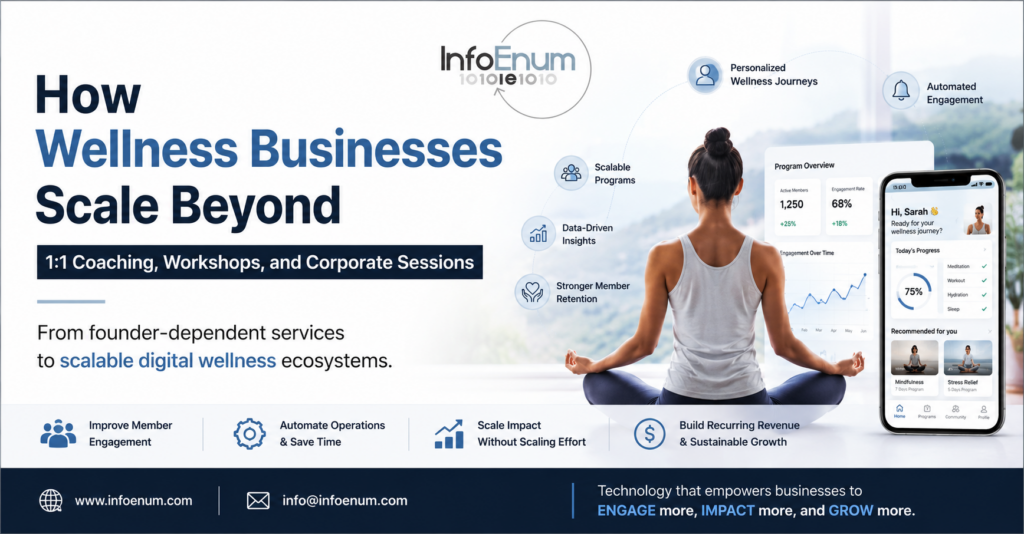
Many wellness businesses start with a simple and effective model.
In the early stages, growth comes naturally through referrals, relationships, and personal involvement.
But eventually, many wellness businesses encounter the same challenge:
Growth becomes tied directly to the founder’s time.
The business grows, but operational complexity grows even faster.
Most wellness organizations don’t struggle because of a lack of demand.
They struggle because their systems aren’t designed to scale.
Common challenges include:
As the client base grows, these manual processes consume more time and reduce the team’s ability to focus on delivering value.
The most successful wellness organizations are moving beyond traditional service delivery models.
They’re building digital ecosystems that keep members engaged before, during, and after sessions.
Examples include:
Members receive customized experiences based on their goals, progress, habits, and engagement patterns.
Users can access content, programs, coaching resources, reminders, and progress tracking from anywhere.
Notifications, reminders, wellness challenges, habit-building programs, and content delivery help maintain participation without increasing administrative effort.
Organizations gain visibility into participation, engagement, and program performance through real-time reporting.
Digital products create recurring revenue opportunities while extending the value delivered beyond live sessions.
AI is helping wellness businesses create more personalized experiences at scale.
From intelligent recommendations and adaptive wellness plans to behavioral insights and engagement optimization, AI can help organizations serve more people without sacrificing personalization.
The goal isn’t replacing coaches, practitioners, or wellness professionals.
The goal is helping them create greater impact through smarter systems.
The question is no longer:
“How can we schedule more sessions?”
The question is:
“How can we create a wellness experience that continues delivering value between sessions while supporting sustainable business growth?”
The organizations that answer this question successfully will be the ones that scale beyond founder-dependent service models.
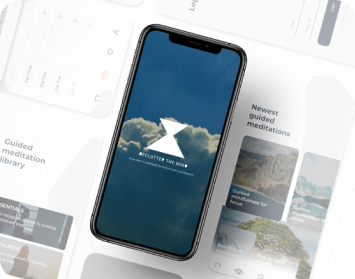
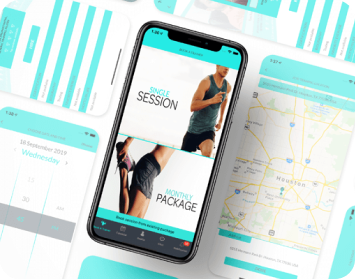
At InfoEnum Software Systems, we’ve had the opportunity to work with wellness, mindfulness, parenting, fitness, and engagement-focused platforms that help organizations create scalable digital experiences, improve retention, and strengthen long-term member engagement.
Technology alone doesn’t create growth.
The right digital strategy does.
AI is transforming every industry — healthcare, fintech, legal, HR, enterprise SaaS. When your platform handles sensitive information, the challenge isn’t just building AI that works — it’s building AI that users, regulators, and enterprises can trust.
Organizations are integrating AI to automate workflows, power recommendations, summarize documents, and improve decisions. But not every application can simply send user data to a public Large Language Model (LLM).
If your application processes:
then security cannot be an afterthought. A single insecure integration can expose sensitive data and permanently damage customer trust.
The question is no longer “How do we add AI?” — it’s “How do we implement AI without compromising security and privacy?”
Many teams connect directly to a public LLM through an API — fine for generic content, risky with sensitive information.
Common risks include:
As AI capabilities grow, so does the attack surface — a security-first architecture reduces these risks.
Security should be built into every stage of implementation, not treated as a final checklist.
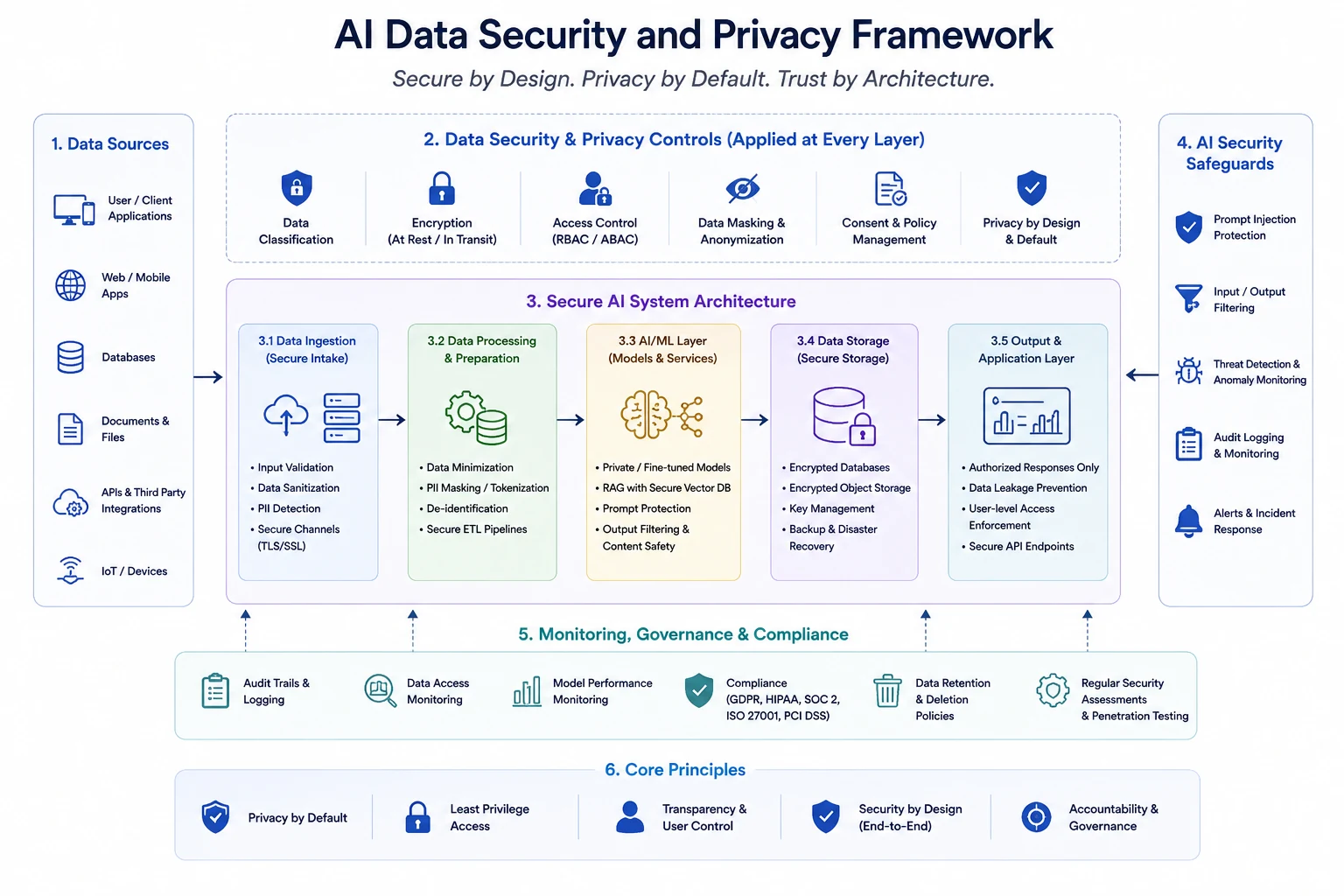
Not every piece of information should be treated equally. Categorize data as Public, Internal, Confidential, Highly Sensitive, or Regulated, then determine what the AI system actually needs — giving it more data than necessary is a common mistake.
Principle: Minimum Data Exposure
Not every AI solution should rely on public models:
Public LLM APIs — for marketing content, documentation, and general productivity.
Retrieval-Augmented Generation (RAG) — ideal when AI must answer from your own knowledge base without retraining, keeping data in your control while staying accurate and current.
Private LLM Deployment — for strict compliance needs, deployed privately for full infrastructure control, stronger governance, and reduced exposure.
Choose architecture based on business risk, not popularity.
AI security extends beyond model selection. Implement end-to-end encryption (at rest and in transit), secure API communication, secret management, key rotation, and network isolation. Sensitive information should never travel unsecured.
AI should never have unrestricted access to enterprise data. Adopt least privilege through Role-Based Access Control (RBAC), document-level permissions, and temporary access tokens. AI should only retrieve what the requesting user is already authorized to view — never a shortcut around your security model.
Where possible, mask PII, tokenize customer identifiers, remove unnecessary metadata, and anonymize datasets used for AI — reducing exposure before processing lowers risk significantly.
Prompt engineering isn’t just better instructions — it’s protecting the system. Secure pipelines validate inputs, sanitize content, prevent prompt injection, and restrict access to confidential context. Prompt security is now a top priority in enterprise AI development.
Security doesn’t stop at deployment. Continuously monitor AI requests, user activity, API usage, prompt history, audit logs, and anomalous behavior. Strong logging strengthens security and simplifies audits and investigations.
Depending on your business, your AI solution may need to align with GDPR, HIPAA, SOC 2, ISO 27001, and PCI DSS. Compliance should shape architecture from the start — not trigger an expensive redesign later.
Technology alone doesn’t guarantee security — architecture does.
Before launching AI in production, ask:
If any answer is “No,” the implementation is likely incomplete.
AI is rapidly becoming a competitive advantage, but success depends on more than the latest model. The most successful AI platforms are built on security, privacy, governance, and trust — a security-first approach doesn’t slow innovation, it enables it, letting organizations confidently adopt AI while meeting regulatory expectations and building for enterprise scale.
Build AI that is intelligent. Build AI that is secure. Most importantly, build AI that people can trust.
At InfoEnum, we help startups and enterprises design and build secure, AI-powered web and mobile applications — spanning Generative AI, Agentic AI, Retrieval-Augmented Generation (RAG), enterprise SaaS, healthcare, and fintech, balancing innovation with security, compliance, and scalability.