The Next Evolution of Wellness Businesses: From Appointments to Scalable Outcomes
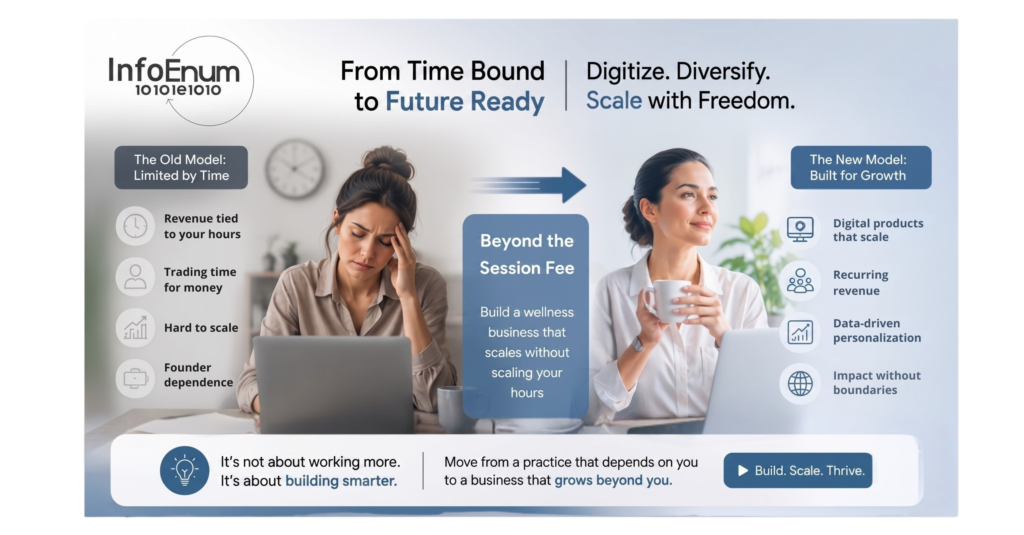
The biggest growth constraint for most wellness businesses isn’t finding clients.
It’s selling time.
One coach. One room. One hour. One client. You can raise your fees, hire more practitioners, run more workshops, but at some point, growth simply requires more hours than a day has.
This isn’t a delivery problem. It’s a business model problem.
The One-Lever Trap
Most wellness and mental health businesses run on a single revenue lever: live sessions.
Coaching calls. Therapy sessions. Workshops. Corporate trainings.
Everything else, content, resources, follow-up usually exists to support that one lever, not to earn on its own.
So founders work harder to grow, instead of building something that grows independently of their calendar.
To be clear, this isn’t an argument against sessions. The highest-performing wellness businesses still center on expert-led care. The shift is about adding scalable revenue alongside it, not replacing the relationship that makes wellness work in the first place.
Where the New Revenue Actually Comes From
- Digital Products & Self-Paced Programs
Picture a therapist who has run the same 12-week anxiety protocol with hundreds of clients. Turned into a structured, self-paced course, say, a $199 program, that same expertise can now reach people who aren’t ready (or able) for 1:1 sessions, while still funneling the right clients into deeper, paid therapy.
- Subscription & Membership Models
A nutrition coach launching a $39/month membership, habit tracking, weekly content drops, monthly group calls, replaces unpredictable, one-off bookings with recurring income. For clients, it also means continuity of care between sessions, not just a transaction.
- Premium, Data-Driven Tiers
As platforms track progress, habits, and engagement, that information can power more personalized plans and recommendations, and a premium tier built around that personalization. To be clear: this is about insights for the client’s benefit, not selling user data. Done well, and with privacy handled properly, it’s simply a more tailored, more responsive experience that a segment of clients will pay extra for.
- Licensing Your Methodology
A practitioner with a proven framework, for stress management, parenting, team resilience, can package and license it to corporates, schools, or other practitioners. The IP becomes a product. The founder earns from the model, not just their hours in the room.
- Community & Cohort-Based Monetization
Peer accountability often matters as much as expert access. Cohort-based programs let members pay for shared momentum and connection alongside guidance, a revenue stream that scales with the group, not with the practitioner’s calendar.
A Note on AI
AI is accelerating all of this, adaptive plans, smarter recommendations, automated check-ins between sessions. It’s a real enabler of personalization at scale. But the deeper shift isn’t the technology itself, it’s the decision to build revenue streams that don’t depend on a practitioner being in the room. AI makes that easier to execute well; it doesn’t replace the decision to do it.
A Simple Way to Think About the Shift
Hours → Products → Memberships → Platform → IP.
Each stage builds on the last. You don’t need to do all five at once, most businesses start with one digital product alongside their core sessions, then layer in a membership once that’s proven, and expand from there.
Why This Matters More Than Ever
If you’re thinking about raising capital, bringing in a partner, or eventually selling the business, recurring revenue and revenue that doesn’t depend on the founder are what investors and acquirers weigh most heavily. A business built entirely on session-based income is valued very differently from one with diversified, scalable revenue.
But the deeper reason this matters isn’t valuation, it’s reach. A self-paced program or membership often serves people who’d never book a $150 session: different budgets, different comfort levels, different starting points. Diversifying revenue and expanding access tend to move together.
The Real Question to Ask
Most founders ask: “How do we get more clients into more sessions?”
The founders building category-defining businesses ask something different:
“What are we capable of offering that doesn’t require us to be in the room, and still gets clients real outcomes?”
The future of wellness belongs to businesses that scale outcomes, not just appointments.
Helping organizations design and build exactly this kind of digital revenue architecture, turning single-stream, founder-dependent practices into scalable, multi-revenue businesses, is exactly the type of work we focus on at InfoEnum Software Systems.
If you run a wellness or mental health business, which revenue stream beyond sessions has worked best for you? I’d love to hear your experience in the comments, or feel free to DM me directly.